


TN (Twisted Nematic) and IPS (In-Plane Switching) are two display technology choices that are widely used in a variety of devices today. Both these display technologies have their unique advantages and disadvantages.
So, in this article, we will explore the key differences between TN vs IPS panels to find out which one is better.
What is TN technology?
TN is a display technology commonly used in computer monitors, LCD screen, conference room TVs and other screens, and it works as follows:
In a TN screen, the liquid crystals take on a spiral/twisted shape, hence the name of the technology.
Once a voltage is applied, the liquid crystals unwind, allowing light to pass through, resulting in a bright white screen. The degree of unwinding controls the amount of light intake. Finally, different colors are created by using color filters to select red, green or blue (RGB) light to pass through each pixel.

What is IPS technology?
IPS is another liquid crystal display technology used on screens such as cell phones, laptops, computer monitors, and televisions, among others. It works as follows:
Unlike TN panels, the liquid crystals in IPS are arranged in a horizontal plane.
When a voltage is applied to the electrodes of an IPS display, the liquid crystals rotate parallel (or in-plane) to control the amount of light passing through. The color filters then produce the rich, vibrant colors we see on IPS monitors.
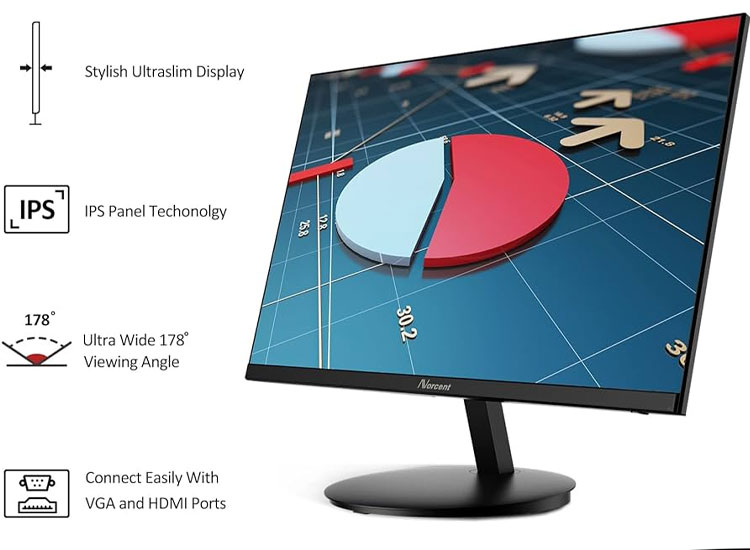
Differences between TN and IPS
As we can see from the descriptions of the two above, the two main differences between how TN and IPS monitors work are the arrangement of the liquid crystals and the way these crystals react to electricity (voltage). In addition to this, there are also differences between TN and IPS when it comes to evaluating some of their performance, so let’s continue to learn more.
Visual Quality
The visual quality of a monitor is judged by two main factors: color reproduction and viewing angle. In both areas, IPS is far superior to TN displays, as IPS can reproduce colors more accurately than TN panels. In fact, IPS is capable of producing 16.7 million colors, making it an excellent choice for graphic designers, photographers, filmmakers and more.
And IPS also has a wider viewing angle. This means that no matter what angle we view the screen from, the colors and contrast on the display remain consistent.
In contrast, TN panels are much less color accurate, producing only 262,144 colors. This can lead to inconsistent colors, color banding, and lower image quality when we need to display certain image details in fine detail.
Additionally, TN monitors have a narrower viewing angle, so when viewed at the wrong angle, this can result in significant changes in the colors and contrast of the screen.
Take the video footage of a leather jacket as an example. When viewed on an IPS monitor, you can see rich textures and subtle changes in color. However, when we watch it on a TN panel monitor, we cannot achieve such a delicate effect.
Refresh Rate
The refresh rate is the number of times a screen image/information is updated per second, measured in Hertz (Hz). A higher refresh rate means smoother motion, smoother visuals and less motion blur, and is a key indicator of screen performance.
IPS panels typically offer higher refresh rates than TN, and IPS screens with refresh rates up to 240Hz are now available on the market, while TN panels typically have a refresh rate of 60Hz, with very few TN products able to reach 96Hz.
Response Time
Response time is the speed at which a pixel changes color. It is measured in milliseconds (ms). Faster response time results in smoother moving images. Currently, there is not much difference in response time between the two, so they are neck and neck in terms of response speed.
Energy Efficiency
One of the few advantages of TN screens is that they are more energy efficient than IPS screens. The reason why TN screens are more energy efficient is because the light transmission of TN panels is so high that TN screens don’t need to be very bright to be visible from the panel. On the contrary, due to the lower light transmission of IPS panels, a higher level of brightness is required to penetrate the panel under the same conditions.
Cost
TN displays are usually cheaper than IPS because the materials used to make them are easier to manufacture. This makes it a viable option for budget-conscious buyers, such as those in the daily office.
Which is better, TN or IPS?
After considering the key factors of display technology, IPS is clearly the better choice. While TN used to have a strong advantage in terms of refresh rate and response time, with the development of IPS technology, these advantages of TN screens have now been completely surpassed.
Also, since TN screens are becoming less and less popular and should be discontinued before long, IPS is the best choice.

